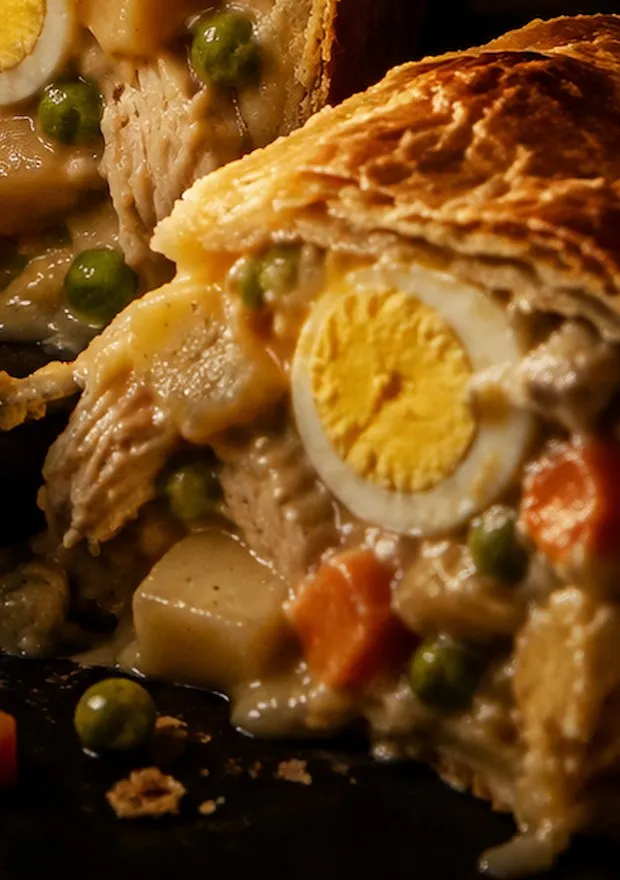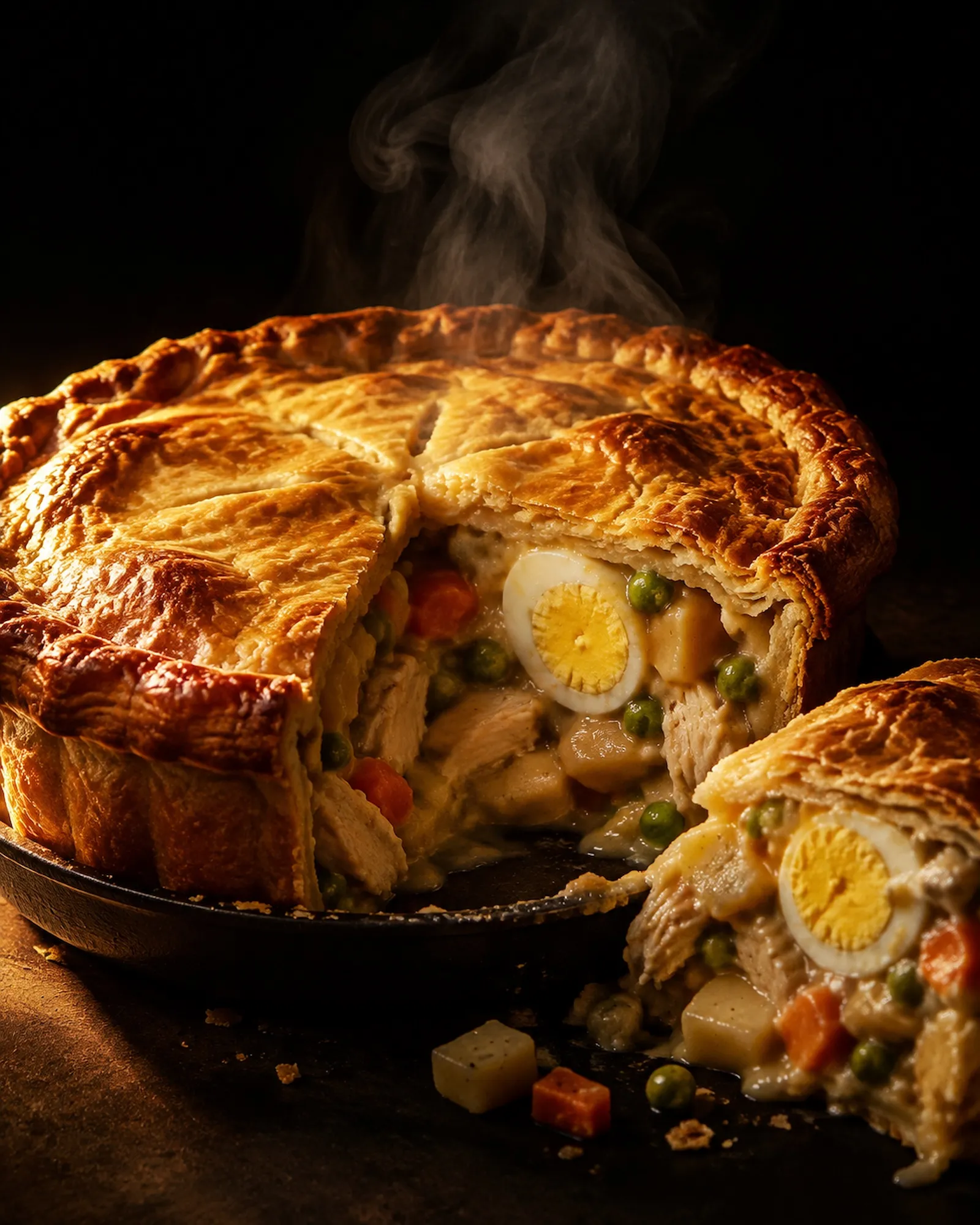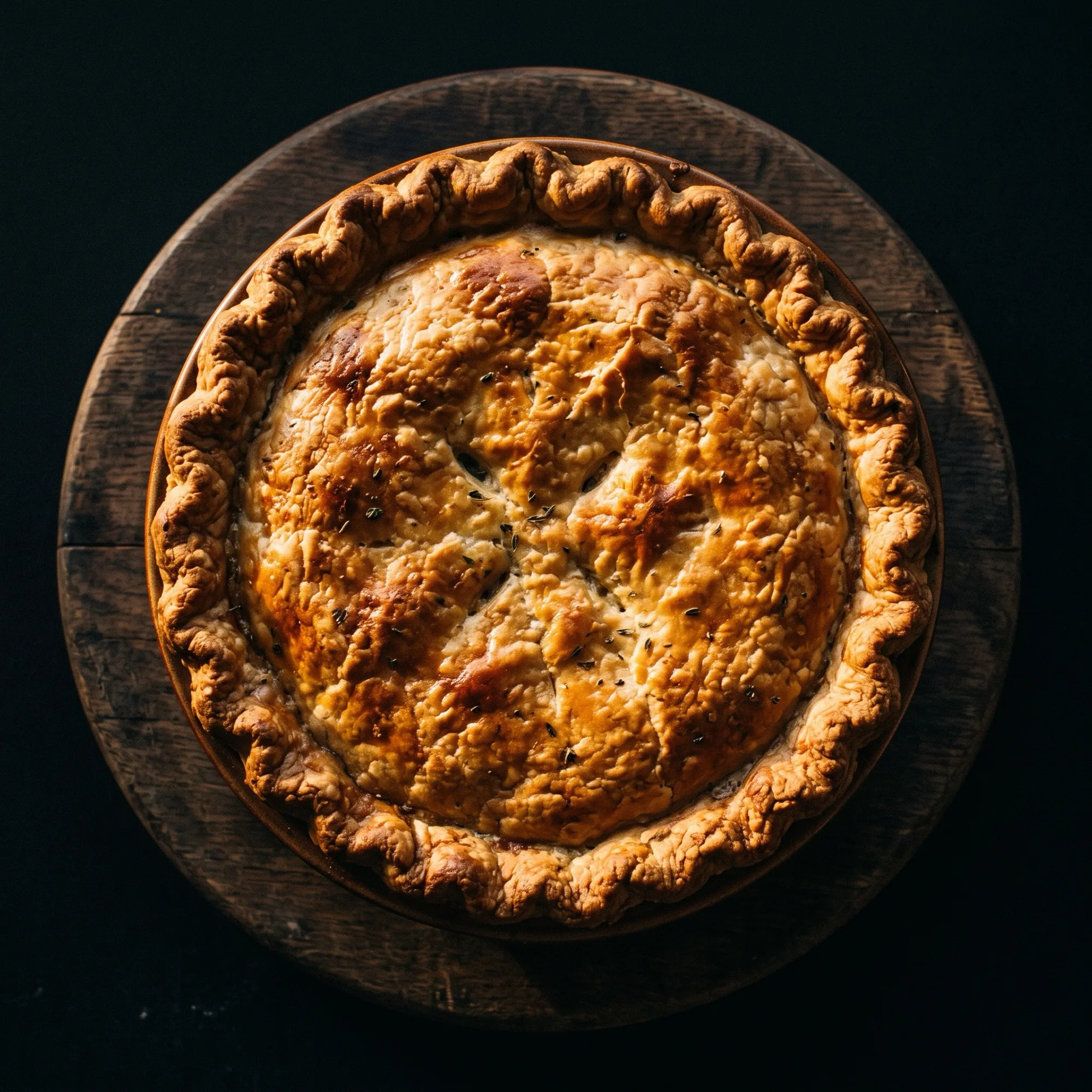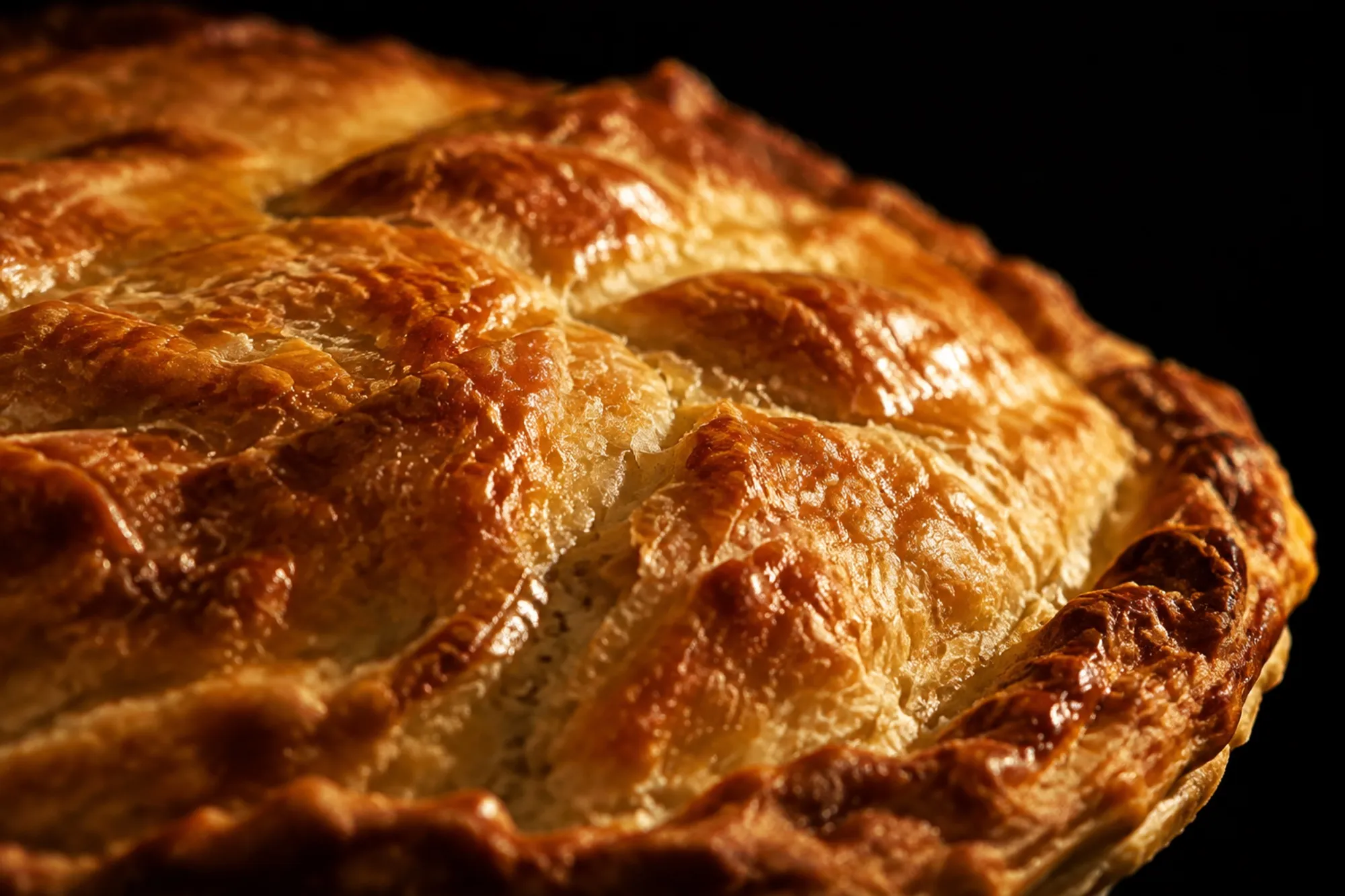
We describe the original Don pie's crust as golden and flaky rather than shortcrust or puff pastry, because it does not sit neatly in either box and food writers have described it both ways. Flakiness comes from layers of fat in the dough turning to steam in the oven. We make our pastry dough in-house and roll it on a dough sheeter for an even crust.
Is the original Don pie made with shortcrust or puff pastry?
We call it golden and flaky, and we leave the label there. The original Don pie’s crust does not sit neatly in either of the usual boxes. Food writers who have tasted it describe it in different ways: buttery and flaky in one review, old-school and puffy in another, balanced between fluffy and crumbly in a third, and thicker and more biscuit-like than a French-style pastry on a pie review site. They are all describing the same crust: the one on DonChef’s Original Chicken Pie, made to the recipe Chef Don Lim created in 1983.
We could pick one of those labels and print it on the menu. We prefer to describe what you will actually find: a crust that is golden on top, flaky as you bite, and sturdy enough to hold a generous filling.
What makes a pie crust flaky?
A pie crust is flaky because of how its fat is distributed. When pastry dough is made, the fat is worked into the flour in small pieces or thin layers rather than fully blended in. In the oven, the water in the dough and the fat turns to steam, and the steam pushes the layers of dough apart. The fat then fries those layers from within. What you bite into is a stack of thin, crisp sheets with tiny air pockets between them.
The more distinct the layers, the more the crust shatters. Puff pastry takes this to an extreme with many folded layers. Shortcrust keeps the fat more evenly mixed and bites more crumbly. Many old-school Singapore chicken pies sit somewhere between the two, which is roughly where ours is. For the general case, chickenpie.net’s guide to puff or shortcrust sets out what each does under a chicken filling. If you want to try the crumblier end of the scale yourself, here is a shortcrust pastry recipe for chicken pies written for Singapore kitchens.
Why does heat matter so much in Singapore?
Heat matters because fat that melts too early cannot make layers. If the fat in a pastry dough softens and blends into the flour before baking, the steam has nothing to separate, and the crust bakes dense rather than flaky. In a tropical kitchen, that is a constant fight.
Pastry cooks in Singapore handle it in different ways. One hotel pastry chef has described chilling shaped pies in a freezer for a couple of hours before baking, because butter melts so quickly in the heat. The principle is universal: keep the dough cool until the oven does its work.
Why do we make our own pastry dough?
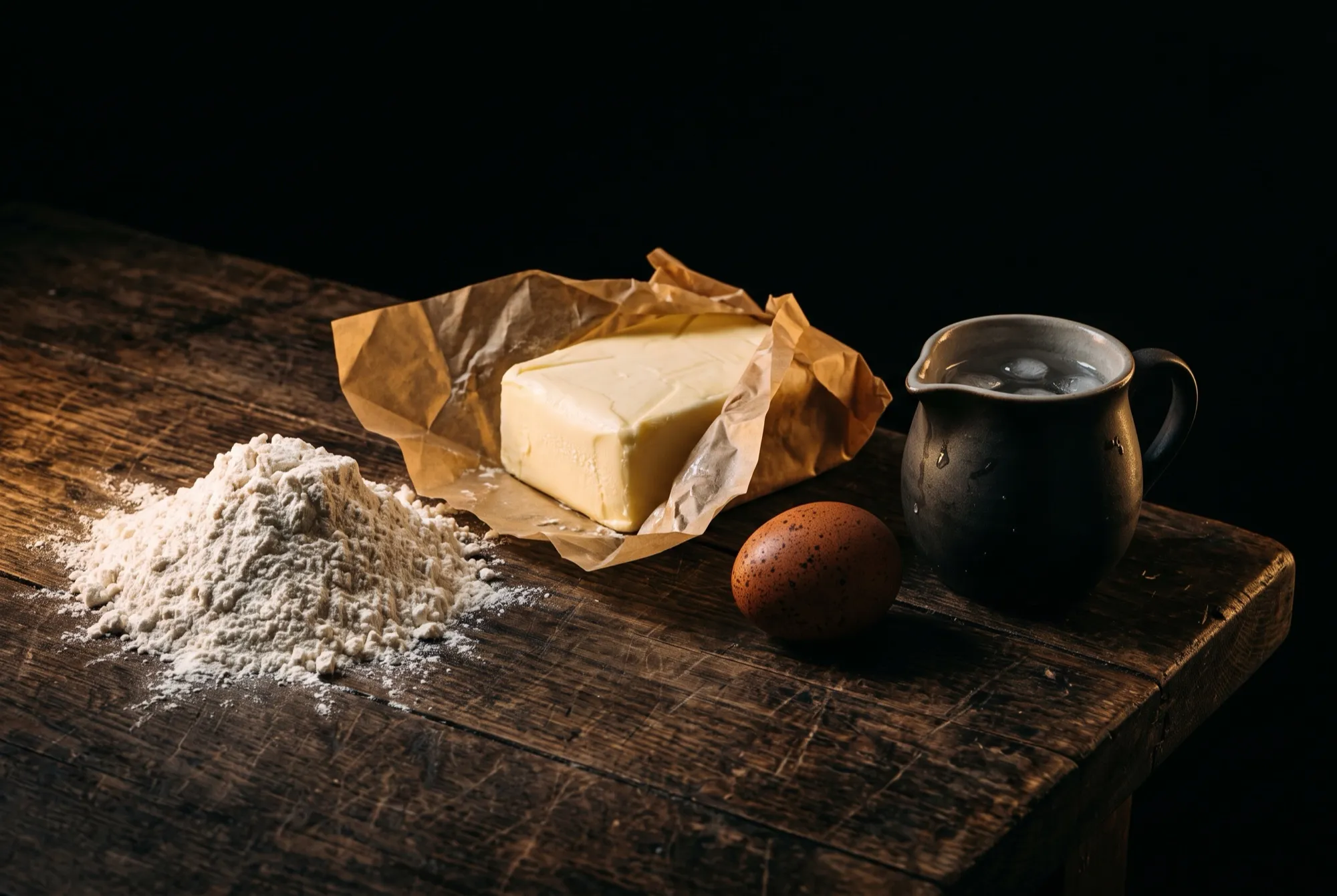
We make our pastry dough in-house because the crust is the part of the pie that takes the most judgement and shows the most mistakes. Bought-in pastry would be easier. It would also make our crust taste like everyone else’s who buys the same block.
Making it ourselves means the crust stays DonChef’s. It also means we can see and correct the small things that change a crust: the feel of the dough on a humid day, how it behaves after resting, how it colours in the oven.
Why use a dough sheeter?
We roll our dough on a dough sheeter because an even crust bakes evenly. A dough sheeter passes dough between rollers set to a fixed gap, so every sheet comes out the same thickness. That matters more than it sounds. A lid that is thick on one side and thin on the other will burn in one place and stay pale in another, and a thin patch in the base is where gravy breaks through.
A sheeter is not a shortcut around skill. It is a way of making sure that skill shows up the same way in every pie, from the first batch of the day to the last.
What should a good crust look and feel like?
A good chicken pie crust should be:
- Golden all over, with deeper colour at the edges and crimp, not pale patches.
- Crisp on top and flaky as you bite, giving way rather than bending.
- Cooked through underneath, with a base that holds when you lift a slice.
- Tender where it meets the filling, where a little of the gravy has softened the inner layer.
- Sealed at the edge, so the gravy stays inside.
That fourth point is often misunderstood. A slightly soft inner layer is not a fault. It is where crust and filling meet, and it is one of the best mouthfuls in the pie.
How do I keep a crust flaky at home?
Keep the crust flaky at home by giving it dry heat when you reheat. A microwave warms the filling but steams the crust soft. An oven or air fryer brings the crisp back. Our ordering guidance for an air fryer is 150C for about five minutes, then 200C for about five minutes, until the pie is piping hot in the centre. Machines vary, so treat any number as a starting point and check the centre. Do not cover the pie with cling film while it is warm, or the steam will soften the lid.
Why the crust is the signature
The crust is the first thing you see, the first thing you bite and the part of a pie most people remember. When customers tell us a pie tastes the way it did years ago, the crust is usually part of what they mean. That is why we make it ourselves, and why we would rather describe it honestly than squeeze it into a category. The rest of the pie, part by part, is in the anatomy of the original Don chicken pie, the crust’s own pie is DonChef’s Original Chicken Pie, and our other essays are collected in the craft notes.
Sources and how we checked
- Chicken Pie Kitchen & Don Signature Crab, pie-making notes and Original Chicken Pie product page (chickenpie.sg)
- SethLui.com, December 2022
- ieatishootipost, April 2023 (partnership post)
- Tasting Table, on the restaurant's chicken pot pie
- Hong Leong hi-life, on hotel chicken pie making in Singapore, December 2018