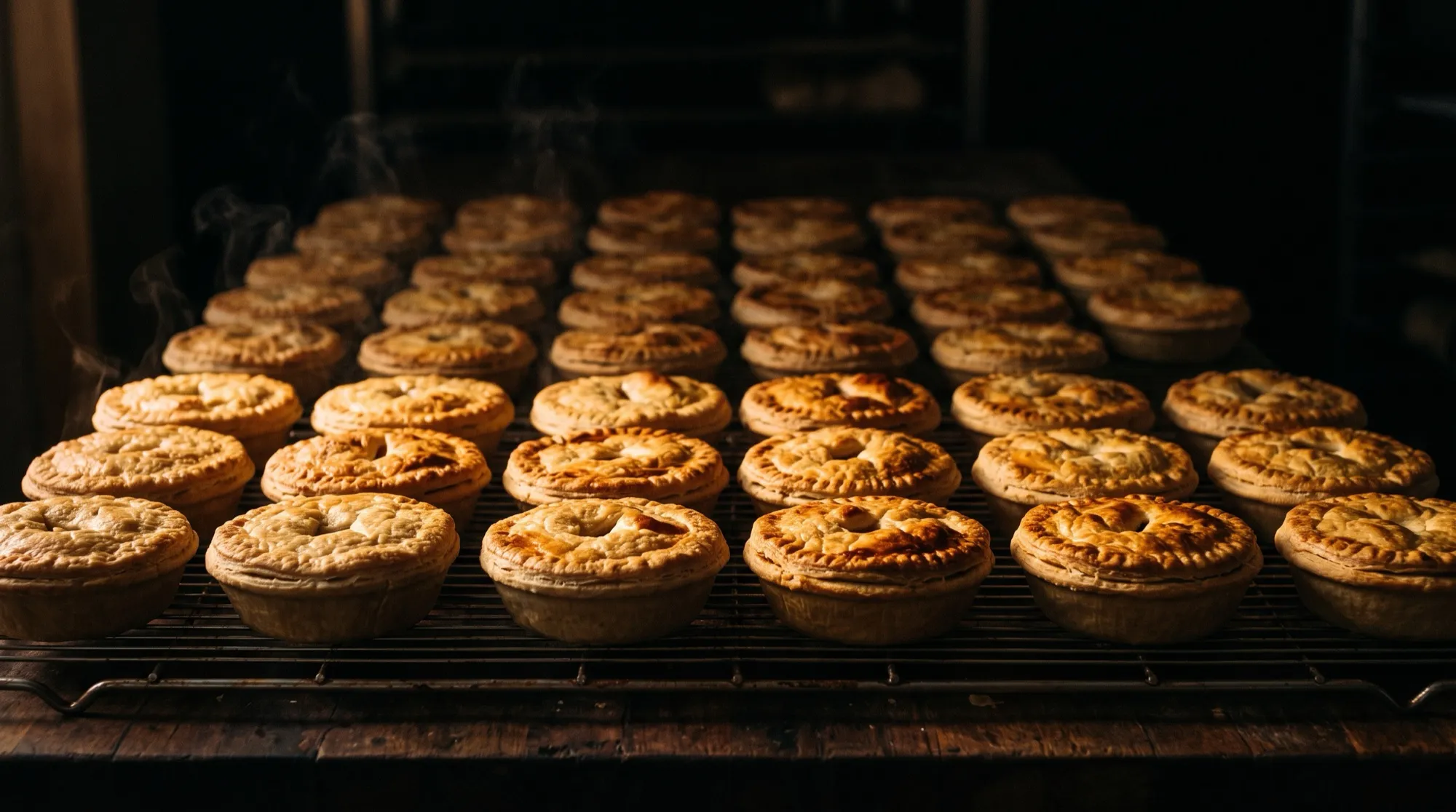
We bake the original Don pie in small batches in deck ovens at 39 Tyrwhitt Road. A deck oven heats the pie from the deck below as well as the air around it, helping the base cook through. Resting a chicken pie for a few minutes after baking or reheating lets the gravy settle, so the slice holds together and the filling is safer to eat.
How is the original Don pie baked?
The original Don pie is baked in small batches in deck ovens at our kitchen at 39 Tyrwhitt Road. That is our standing practice, and it shapes how the pie tastes. We do not publish our oven temperatures or bake times, which depend on the oven, the size of pie and the batch. What we can explain is why we bake the way we do, and how it shows up in the anatomy of the original Don chicken pie.
What is a deck oven, and why use one?
A deck oven is an oven with one or more flat baking floors, or decks, that are heated directly. Trays sit on the hot deck, so a pie receives heat from below as well as from the hot air around it. Bakeries have used ovens like this for bread and pastry for a very long time.
For a pie, the heat from below is the important part. The commonest fault in a filled pie is a pale, soft base, because the filling shields the bottom crust from the heat above. A heated deck cooks the base from underneath while the top browns, so the pie comes out cooked through, not just coloured on top.
Why bake in small batches?
We bake in small batches because a small batch is easier to bake well and easier to keep fresh. Every tray in a small batch gets similar heat, so pies come out evenly. And because we sell our pies on the day they are baked, baking in smaller batches lets a kitchen match what comes out of the oven to what the outlets need, rather than baking everything at once and hoping. Our zero overnight pies note explains that rule.
What happens to a pie in the oven?
A lot happens to a chicken pie in the oven, roughly in this order:
- The fat in the crust melts and the water turns to steam, lifting the pastry into flaky layers.
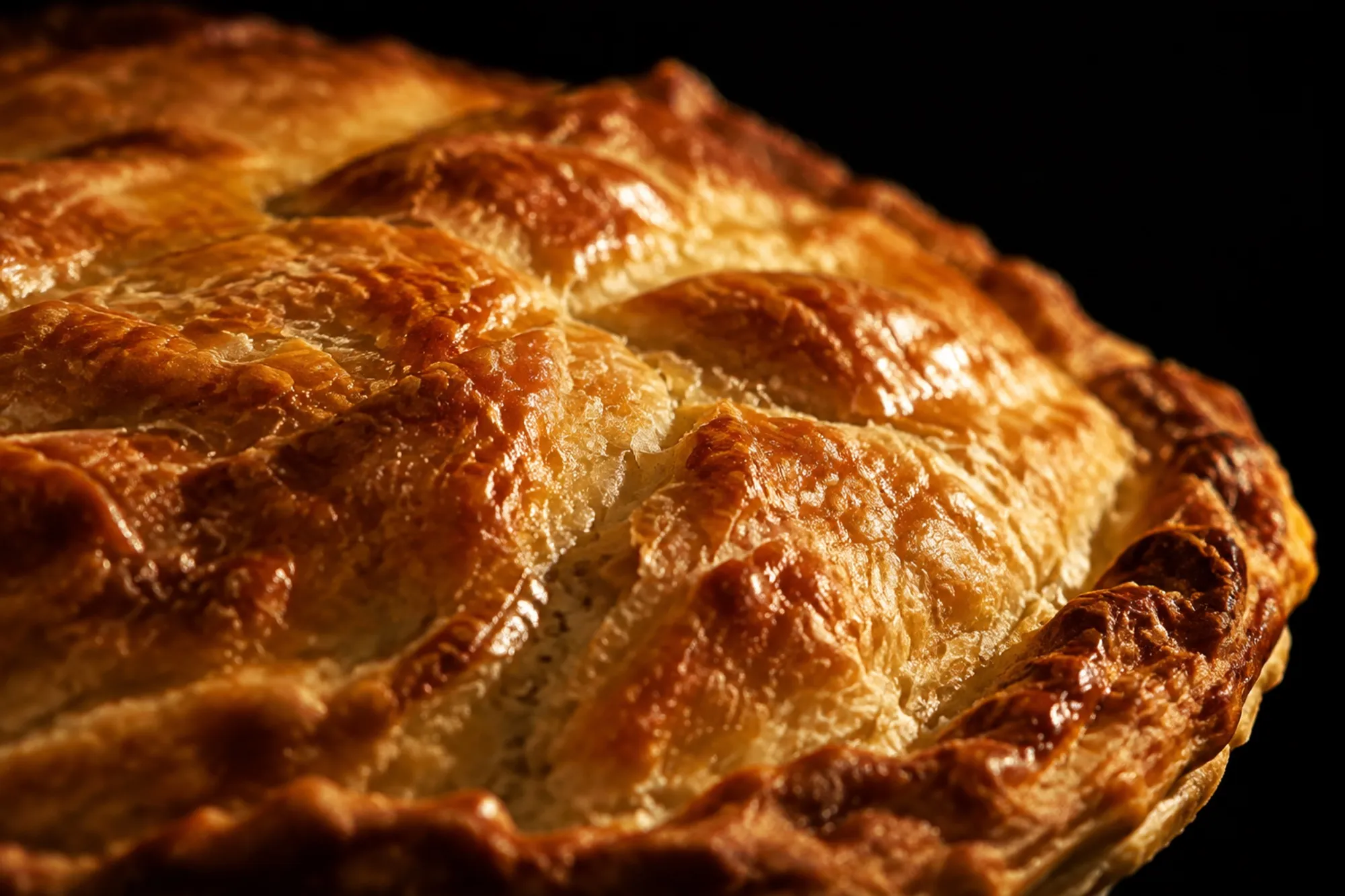
- The surface of the crust browns, giving colour and much of the pie’s aroma.
- The base sets, if it gets enough heat from below.
- The filling heats through, and the gravy thins slightly as it warms, then bubbles.
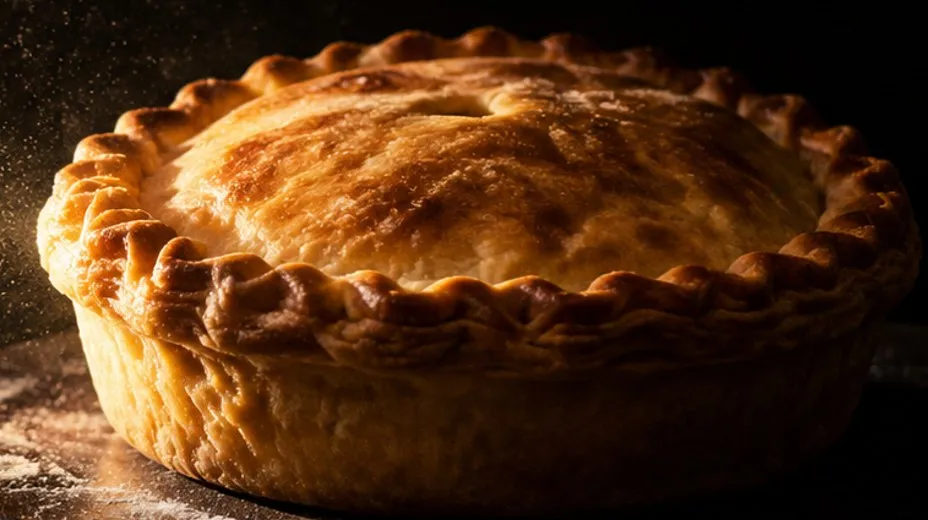
- The crimped edge seals harder, holding the gravy in.
If any one of these goes wrong, the pie shows it. Underbaked pies have pale tops and soggy bases. Overbaked pies have dry edges and gravy that has boiled out through the crimp.
Why should a chicken pie rest before cutting?
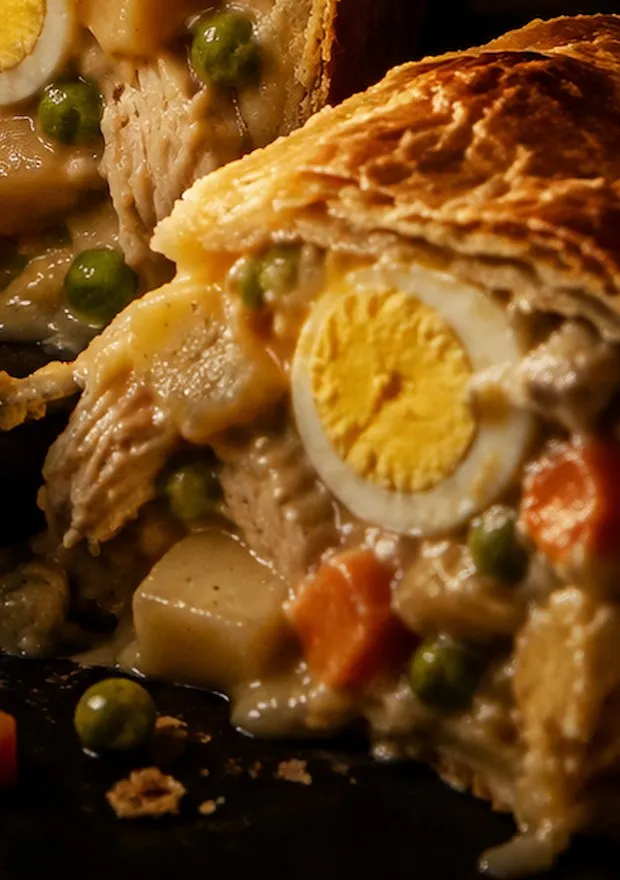
A chicken pie should rest before cutting because the gravy needs time to settle. Straight from the oven, the filling is at its runniest and the steam inside is at its highest pressure. Cut it immediately and the gravy runs out across the plate, the slice collapses and the base soaks. Leave it for a few minutes and the gravy thickens slightly as it cools from bubbling point, so a slice holds together.
Resting is also kinder to your mouth. The centre of a freshly baked or reheated pie can be much hotter than the crust suggests. A short rest lets the heat even out.
How long should I rest a pie after reheating?
Rest a personal pie for about a minute after reheating and a whole pie for a few minutes, then cut. First, make sure the centre is piping hot (75C on a food thermometer). Our ordering guidance for an air fryer is 150C for about five minutes, then 200C for about five minutes. For the best results, our guidance is to enjoy a pie within about four hours of buying it, or chill it and eat within three days. If the pies have a journey ahead of them first, read up on how to store, transport and reheat pies in Singapore heat.
Baking well is about patience
Most of what we have described here is patience. Waiting for dough to rest. Letting the oven come to heat. Baking a small batch rather than a big one. Giving a pie a minute before you cut it. None of it is secret, and none of it is quick. It is just what a pie needs, and it is what our kitchen gives it every day it bakes. The crust side of the story is in the golden, flaky crust, and the rest of our craft notes cover the filling, the egg and the seasoning.
Sources and how we checked
- Chicken Pie Kitchen & Don Signature Crab, pie delivery announcement and pie-making notes (chickenpie.sg). Small batches, deck ovens, in-house dough
- buy.chickenpie.sg ordering FAQ. Air fryer reheating guidance